
Combination Gas Control Valves: How to Specify a Functional Equivalent for a European Appliance
A combination gas control valve integrates a safety shut-off, a pressure regulator and the main operating valve in a single certified body — which is exactly why it is one of the hardest components in a gas appliance to substitute. Specifying an equivalent takes eight parameters, not a part number.
When the original becomes unavailable — discontinued, on a long lead time, or single-sourced — the problem lands on an engineer's desk rather than a buyer's. This guide is not a cross-reference table. It is the list of things you need to establish before anyone can tell you whether an equivalent exists: the eight parameters, the two that cause most substitution failures, and what genuinely changes when the appliance is destined for Europe rather than North America.
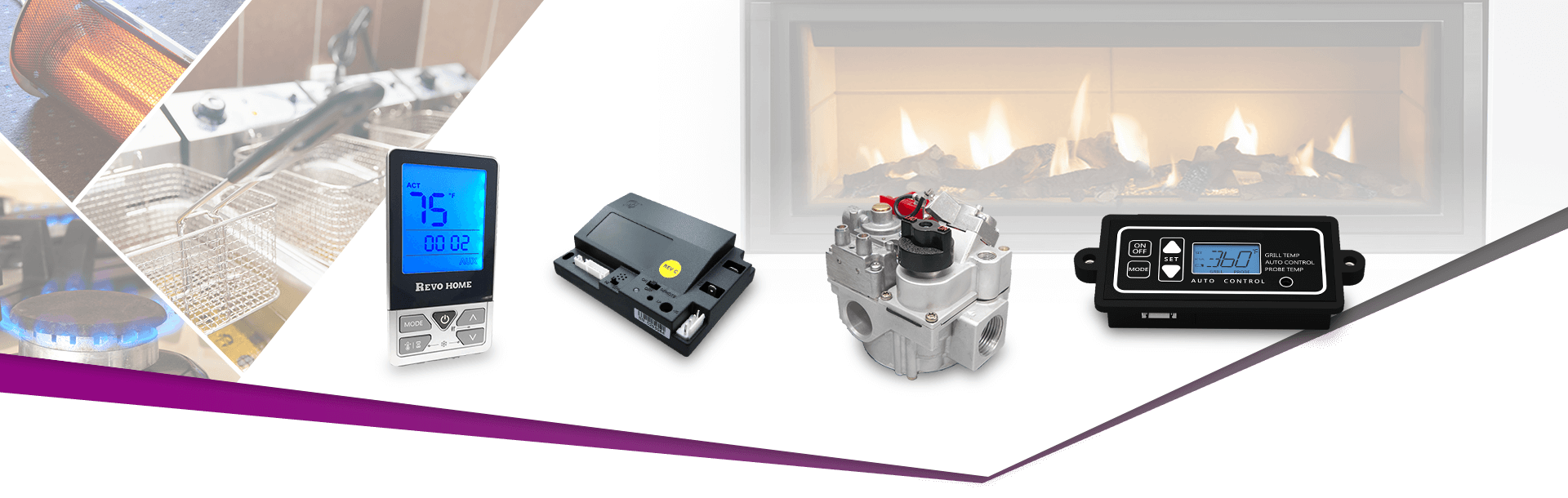
Grand Mate is a Taiwanese manufacturer of gas valves, gas ignition control modules, gas fireplace remote controls and water heater pilot assemblies. Its combination gas valve range covers ten model families — GM970, H3V, M6003V, 6003V, GM913, GM985, GM983, GM982, GM935 and GM981 — supplied to OEM appliance makers as single components, as matched modules, or through ODM development.
What is a combination gas control valve?
A combination gas control valve is a single body that integrates three functions which would otherwise be separate components plumbed in series: a safety shut-off driven by flame supervision, a pressure regulator that holds outlet pressure at a set value, and the main operating valve. Many designs add a pilot circuit, a modulating or servo stage, and a manual on/off/pilot selector into the same casting.
The word combination describes the packaging, not the function. The trade-off is worth stating plainly:
- What integration buys you: fewer joints, fewer potential leak paths, a smaller envelope, and one certified item instead of several.
- What it costs you: granularity. The regulation range cannot be changed without touching the safety function, so a small requirement change can mean a different part rather than a different setting.
- Why it is certified as a unit: the safety function is part of the assembly, so no portion of it can be substituted independently.
For the distinction between manual, automatic and combination types, see our note on manual, automatic and combination gas valves.
Which eight parameters define an equivalent combination gas control?
Eight parameters define a functional equivalent: connections and thread standard, capacity, gas family and supply pressure, actuation, outlet pressure regulation, ignition and flame supervision architecture, mechanical envelope, and the approvals for the target market. Bring all eight to a supplier and the conversation takes minutes. Leave any of them open and you will be quoted a part that fits the pipe and fails the certification.
| # | Parameter | What to record |
| 1 | Connections | Inlet and outlet size, and the thread standard — ISO 7-1 (R/Rp) or NPT. Plus the pilot outlet: compression tubing size or threaded fitting |
| 2 | Capacity | Rated throughput in kW (or BTU/h), stated at a defined pressure drop. Capacity without a pressure drop is not a specification |
| 3 | Gas family and supply pressure | Second family (G20, G25, G25.3) or third family (G30, G31), and the nominal supply pressure of your market |
| 4 | Actuation | 24 V AC, 230 V AC, 12 V DC, millivolt (thermopile-powered) or manual — plus current draw and terminal type |
| 5 | Outlet pressure regulation | Fixed or adjustable, the range, and the set point for each gas the appliance is approved for |
| 6 | Ignition and flame supervision | Standing pilot with thermocouple, intermittent pilot with an ignition module, or direct spark — and which device supervises the flame |
| 7 | Mechanical and environmental | Mounting orientation, envelope, knob or shaft interface, ambient temperature range, ingress protection |
| 8 | Approvals for the target market | Which certification the appliance will be assessed under, and which gases and capacities that certificate covers |
Why do threads and gas families cause most substitution failures?
Threads and gas families fail silently, which is why they cause more substitution problems than capacity or voltage. European gas connections are commonly specified to ISO 7-1 (R taper, Rp parallel); NPT has a different thread form and taper angle, so the two will start to engage and will not seal reliably. A part dimensioned in inches with NPT threads makes the connection a change item, not a detail.
Gas families are the second trap. Supply pressures differ by family and by market:
| Gas family | Designation | Nominal supply pressure | Common use |
| Second family | G20 (natural gas) | 20 mbar (≈ 8.0 in WC) | Most of Europe |
| Second family | G25 / G25.3 | 25 mbar | Parts of the Benelux region |
| Third family | G30 (butane) | 28–30 mbar (≈ 11.2–12.0 in WC) | Cylinder LPG |
| Third family | G31 (propane) | 37 mbar (≈ 14.9 in WC) | Cylinder and bulk LPG |
The conversion is straightforward — 1 mbar is roughly 0.40 in WC, and 1 kW is roughly 3,412 BTU/h — but the conversion is not the point. A control factory-set to regulate at 3.5 in WC is regulating at about 8.7 mbar, which tells you immediately it was set up for a North American natural gas manifold. Whether that set point suits a European appliance is a design question, and the answer is frequently no.
Why don't approvals transfer with the part?
Approvals are scheme-specific and do not travel with the hardware. Under Regulation (EU) 2016/426, a gas control is a fitting and requires EU type-examination through a notified body before it can be CE marked; the full regulation is published on EUR-Lex. A control certified to CSA or ANSI Z21 has been assessed under a different legal framework and is not recognised in the EU.
The certificate also covers specific gases and capacities, so "it is certified" is not the same as "it is certified for what you are doing." What to request is set out in our guide to gas valve CE certification under EU 2016/426.
What should you record when replacing a legacy 24 V combination control?
Record eight items from the control you are removing: full part number and label data, connection sizes and thread form, rated capacity against the appliance's actual input, coil voltage and current, regulator set point as found, maximum inlet pressure, the flame supervision method in use, and the physical envelope. Photograph rather than transcribe — label data is frequently misread.
The controls we are asked about most often are the long-established 24 V AC combination gas controls, with the Robertshaw 700 series and Honeywell's combination gas controls the two families customers name.
Grand Mate is an independent manufacturer and is not affiliated with, authorised by or endorsed by Robertshaw or Honeywell. These names are used here only to identify the type of control our customers describe. We do not publish drop-in compatibility claims; whether an equivalent exists for a given application is confirmed by engineering review, per project.
With that said, here is what any engineer will ask you for:
- The full part number and all label data, photographed rather than transcribed
- Inlet, outlet and pilot connection sizes, and the thread form
- Rated capacity, and the appliance's actual input rating — they are frequently different
- Coil voltage and current draw, and the terminal type
- Regulator set point as found, and whether the appliance was converted between gases
- Maximum inlet pressure the appliance is designed for
- How the flame is supervised today, and what the control board expects to see
- The physical envelope: what the valve is bolted to, and what it must clear
A photograph of the installed valve with the surrounding pipework visible is worth more than a page of written description.
Standard part, modified platform, or new tooling — which route are you on?
There are three honest routes, and knowing which one applies changes the schedule more than any other decision in the project. Most ODM work sits in the middle route: the certified valve body and its safety function stay as they are, and what changes sits around them.
| Route | What changes | Typical situation | Commercial reality |
| Standard part | Nothing | All eight parameters land inside an existing range | Confirm certificate scope and order — fastest, lowest risk |
| Modified platform | Connection thread, pilot fitting, regulator setting, knob interface, wiring harness, orientation, gas setup | Specification is close but not identical | Where most ODM projects land, and usually the right answer |
| New design and tooling | Valve body and certification | No existing platform is close enough | Carries development cost and tooling investment; needs volume to make sense |
Grand Mate's position on the third route is deliberately not "we customise anything." New development is quoted where the volume supports it and the development cost is shared. Saying so at the first meeting saves both sides a quarter of pleasant conversations that go nowhere.
What information should you send with an RFQ?
Send seven items and an engineer can normally tell you within a few working days which of the three routes applies: the control being replaced or the target specification, appliance type and rated input, gas families and supply pressures, electrical interface, space envelope, the certification the appliance will be assessed under, and annual volume with target start of production.
- The control being replaced, or the specification if this is a new design
- Appliance type and rated input in kW
- Gas families and supply pressures for every market you will sell into
- Electrical interface — supply voltage, control board, terminal type
- Space envelope and mounting arrangement, with a drawing or photograph
- Certification the appliance will be assessed under
- Annual volume and target start of production
Which appliances use combination gas controls, and what constrains each?
Combination gas controls are used across seven appliance categories, and each has a parameter that tends to be the binding constraint. Identifying that constraint early is usually more useful than comparing datasheets side by side.
| Application | Binding constraint |
| Gas heaters | Envelope and knob interface — the control sits behind a fascia |
| Water heaters | Regulation stability across a wide modulation range |
| Commercial stoves | Capacity and ambient temperature, both near the top of the range |
| Fireplaces | Flame supervision architecture, plus remote and thermostatic control |
| Barbecues | Third-family gas at cylinder pressures |
| Outdoor heaters | Outdoor ambient conditions and ignition reliability |
| Ovens | Thermostatic control integrated with the safety function |
Supply form varies with the project. Some customers buy the combination valve alone; others take it as a module with a water heater pilot assembly and a gas ignition control module, which moves the interface work to the supplier and out of your bill of materials.
Frequently asked questions
What is a combination gas control valve? A combination gas control integrates a safety shut-off, a pressure regulator and the main operating valve into a single body, often with a pilot circuit and a manual selector as well. It is used where a gas appliance needs regulation and flame-failure protection in one certified component rather than several plumbed in series. Because the safety function is part of the assembly, it is certified as a unit and cannot be partially substituted.
Is a 24 V combination gas valve interchangeable with a millivolt valve? No. A 24 V AC control is opened by a coil energised from a transformer or control board. A millivolt control is powered by the thermopile in its own pilot flame, generating a few hundred millivolts with no mains or transformer supply at all. The two have different coil resistances, different control logic and different failure behaviour, so substituting one for the other changes the appliance's control architecture rather than just a part number.
Can a control specified for natural gas be used with LPG? Only through a proper conversion, and only within what the certification covers. Changing gas family means changing the injector, resetting or changing the regulator, re-checking flame supervision response, and confirming the certificate lists that gas. Supply pressures differ substantially — a nominal 20 mbar for G20 natural gas against 28–30 mbar for G30 butane and 37 mbar for G31 propane — so this is a design change, not a field adjustment.
What is the minimum order quantity, and can you develop a custom control? Standard parts from an existing range have a conventional MOQ and the shortest lead time. Modifications to an existing platform are quoted per project. A fully new design with new tooling carries development cost and a tooling investment and is quoted where annual volume supports it — Grand Mate quotes new development where the volume justifies it and the development cost is shared, rather than offering unlimited customisation.
What information do you need to quote a custom gas control? Seven items: the control being replaced or the target specification, appliance type and rated input in kW, gas families and supply pressures for every market, the electrical interface, the space envelope with a drawing or photograph, the certification the appliance will be assessed under, and annual volume with target start of production. With those, an engineer can usually respond within a few working days.
Do you provide a cross-reference list for other manufacturers' controls? Not as a published table. Compatibility depends on the appliance, not only on the valve, and a table read out of context creates risk for both sides. Send the control you are replacing along with the appliance details and Grand Mate will confirm in writing what does and does not correspond.
Send the control, not just the part number
If you are replacing a combination gas control, the fastest route to an answer is a photograph of the valve in place, the appliance's rated input, the gas families you sell into, and the market you are certifying for. That is enough for an engineer to tell you whether a standard part fits, what a modification would involve, or whether the honest answer is that this one needs a new design.
Vague enquiries get vague quotations. Specific ones get a route, a timeline and a certificate scope.
Browse the combination gas valve range, or read about OEM and ODM gas valve engineering before you send the enquiry.
Contact us: https://www.grandmate.com/contact/contact.html Email: [email protected]