
Gas Valve CE Certification in Europe: What EU 2016/426 Requires From Your Control Supplier
Gas valve CE certification in Europe is governed by Regulation (EU) 2016/426, and the short answer is this: a gas valve is a fitting, it carries the CE marking in its own right, and no manufacturer can self-declare it. A notified body is involved in every legitimate route.
That matters because the appliance manufacturer carries the legal responsibility for the finished product. Every valve, ignition module and pilot assembly inside it has to hold up when a market surveillance authority asks. So the first question in most European sourcing conversations is not about price — it is some version of what will you give me for my technical file?
The answer many suppliers give is "yes, we have CE." That is not enough, and under the current regulation it is not even the right shape of answer. This guide sets out what the regulation requires, what changed in 2018, which EN standards sit behind a certificate, and the eight documents to request before approving a new control supplier.
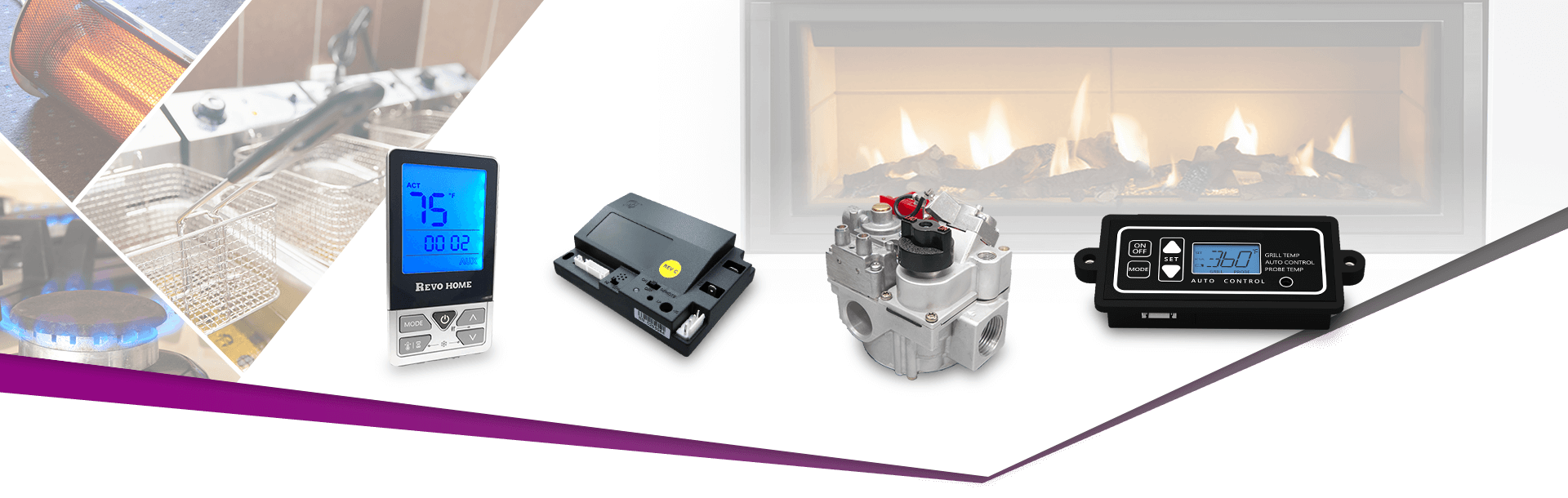
Grand Mate is a Taiwanese manufacturer of gas valves, gas ignition control modules, gas fireplace remote controls and water heater pilot assemblies, supplying OEM appliance makers in Europe, North America and the Middle East. For appliance manufacturers who need a control backed by verifiable certification documents rather than a marketing claim, the value is in the paperwork as much as the part.
Is a gas valve an appliance or a fitting under EU 2016/426?
A gas valve is a fitting, not an appliance. Regulation (EU) 2016/426 defines a fitting in Article 2(2) as "safety devices, controlling devices or regulating devices and sub-assemblies thereof, designed to be incorporated into an appliance or to be assembled to constitute an appliance." An appliance is the finished gas-burning product: a cooker, water heater, fireplace, patio heater or commercial range.
The distinction decides which obligations apply to whom. Everything in the combustion control category on your bill of materials is a fitting:
- Gas valves, including combination gas controls
- Gas ignition control modules
- Water heater pilot assemblies
- Pressure regulators, thermostats and flame supervision devices
Both categories go through conformity assessment. Both carry the CE marking. But the documentation that has to travel with a fitting is different, and that difference is where most sourcing problems start.
Why did the CE marking rule for gas fittings change in 2018?
Fittings did not carry the CE marking under the old Gas Appliances Directive (2009/142/EC). Regulation (EU) 2016/426 replaced that Directive on 21 April 2018 and deliberately reversed the rule, so gas valves sold into the EU today are CE marked in their own right. Recital 49 of the Regulation gives the reasoning: simplification, and avoiding confusion for manufacturers meeting their obligations.
The full text of Regulation (EU) 2016/426 is published on EUR-Lex, and Recital 49 reads:
"Fittings are not appliances but intermediate products intended for appliance manufacturers and designed to be incorporated into an appliance. However, fittings should satisfy the essential requirements so as to fulfil correctly their intended purpose when incorporated into an appliance… it is considered justified that fittings should also bear the CE marking."
Article 17(1) makes it operative: the CE marking is affixed "to the appliance and the fitting or to their data plate as far as relevant."
This is a practical screening tool. A supplier who still describes their valves the way the industry described them before 2018 — certificate of conformity, no CE mark on the part — is working from a superseded framework, and that is worth knowing before a sample arrives.
Can a gas valve manufacturer self-declare CE conformity?
No. In many CE marking regimes a manufacturer may assess its own product and declare conformity with no third party involved, but gas fittings are not one of those cases. Article 14 of the Regulation sets out five routes, and every one of them requires a notified body. There is no legitimate path to a CE marked gas valve without an independent, EU-designated assessment body.
| Route | Modules | Annex III reference |
| Series production, option 1 | Module B (EU type-examination) + C2 — internal production control plus supervised checks at random intervals | Points 1 and 2 |
| Series production, option 2 | Module B + D — quality assurance of the production process | Points 1 and 3 |
| Series production, option 3 | Module B + E — product quality assurance | Points 1 and 4 |
| Series production, option 4 | Module B + F — product verification | Points 1 and 5 |
| Single unit or small quantities | Module G — conformity based on unit verification | Point 6 |
How can you check a gas valve's CE marking in two seconds?
Look for the notified body number. Article 17(3) requires the CE marking to be followed by "the identification number of the notified body involved in the production control phase" and the last two digits of the year the marking was affixed. A CE mark on a gas control with no four-digit notified body number after it is either misapplied or copied from a different regime.
Why do scope and expiry matter more than the certificate itself?
A certificate covers named models, specific gas families and a defined capacity range — so "we are certified" is a claim about a company, while a certificate is a statement about listed products. Two follow-up questions settle it: which models appear on the certificate, and when does it expire? The Regulation introduced a defined validity period for EU type-examination certificates, where certificates issued under the old Directive were often open-ended.
What must the EU declaration of conformity for a fitting contain?
The EU declaration of conformity for a fitting must state the characteristics of the fitting and explain how to incorporate it into an appliance. This is set out in Article 15(3), and Article 15(6) adds that a copy must be supplied with the fitting. It is not a formality the supplier files away — it is a working document written for the appliance manufacturer, in a language appliance manufacturers and market surveillance authorities can understand (Article 7(7)).
Article 15(3) in full:
"In order to assist compliance of finished appliances with the applicable essential requirements set out in Annex I, the EU declaration of conformity for a fitting shall state the characteristics of the fitting and shall contain instructions on how the fitting should be incorporated into an appliance or assembled to constitute an appliance."
What does a usable declaration of conformity contain?
- The manufacturer, and the specific products it covers, by model
- A statement that the essential requirements of Annex I are met
- The harmonised standards applied, including edition year
- The notified body, its identification number, and the certificate reference
- The characteristics of the fitting: gas family, pressure range, capacity, electrical rating, connections
- Instructions for incorporation, assembly, adjustment, operation and maintenance
A one-page certificate with a logo and no incorporation instructions does not do the job Article 15(3) describes, and it will not carry weight in your own technical file.
Which EN standards apply to gas valves and controls?
Conformity is assessed against harmonised European standards, and which ones apply depends on what the control does. A single automatic shut-off valve, an integrated multifunctional control and an electronic burner control system are assessed against different documents. The European Commission publishes the Gas Appliances Regulation framework and its harmonised standards.
| Standard | Covers | Typically relevant to |
| EN 126 | Multifunctional controls for gas burning appliances | Combination gas controls integrating regulation, safety shut-off and main valve |
| EN 125 | Flame supervision devices — thermoelectric flame supervision | Standing pilot and thermocouple-based safety systems |
| EN 88-1 | Pressure regulators for inlet pressures up to and including 500 mbar | Controls with integral outlet pressure regulation |
| EN 161 | Automatic shut-off valves for gas burners and gas appliances | Solenoid and automatic safety shut-off valves |
| EN 298 | Automatic burner control systems | Electronic ignition and flame supervision modules |
Why is the edition year part of the specification?
EN 126 was reissued in 2025 and EN 161 was amended in 2025, and when a standard is revised, certificates issued against the superseded edition remain valid only for a defined period. That is why a declaration must name the edition, and why "conforms to EN 126" without a year is an incomplete statement. For a product with a ten-year service life, ask which edition the certificate is written against and when the supplier plans to requalify.
Can a CSA- or ANSI-certified gas valve be used in a European appliance?
Not without European certification. A control certified to CSA or ANSI Z21 requirements has been assessed against different standards, by a different category of body, under a different legal framework, and the schemes are not mutually recognised. The same applies in reverse to a CE marked control entering North America.
Two practical consequences when re-sourcing from a North American original:
- Threads differ. European gas connections are commonly specified to ISO 7-1 (R taper, Rp parallel). NPT has a different thread form and taper angle and will not seal reliably against them.
- Gas families differ. A control set up for North American natural gas and LP supplies is not automatically suited to the second- and third-family gases and supply pressures used across Europe.
Matching a body size is rarely enough. The full parameter list is covered in our guide to specifying a combination gas control valve.
What documents should you request from a gas control supplier?
Request eight documents before approving a supplier: the EU declaration of conformity, the EU type-examination certificate, the notified body's identity, the standards applied with edition years, incorporation instructions, a technical datasheet, the certified gas families and pressures, and an in-date quality management certificate. A supplier who works in the European market regularly will produce these without difficulty.
| # | Document | What it proves |
| 1 | EU declaration of conformity, per model | The manufacturer's formal claim, with characteristics and incorporation instructions |
| 2 | EU type-examination certificate | That a notified body assessed the type — check scope and expiry |
| 3 | Notified body name and identification number | That the number after the CE mark is real and traceable |
| 4 | Harmonised standards applied, with edition years | That the assessment is against current documents |
| 5 | Incorporation, assembly, adjustment, operation and maintenance instructions | Article 15(3) compliance, and usable engineering data |
| 6 | Technical datasheet | Dimensions, connections, capacity, pressure range, electrical rating |
| 7 | Certified gas families and supply pressures | That the certificate covers the markets you sell into |
| 8 | Quality management system certificate, in date | Ongoing production control, not a one-off sample |
If any item cannot be supplied, that is useful information early rather than late.
How does Grand Mate document its gas controls?
Grand Mate holds Gas Appliances Regulation certification through Intertek under certificate reference ITS-2575-GAR-2232029, CE certification covering the GM982A gas valve, ISO 9001:2015 quality management certification, and CSA certificate of compliance 80169629 for customers running parallel North American programmes. All are published on the company's certification page.
The item most often missing from a component supplier's profile is the last one: Grand Mate operates an in-house testing laboratory accredited to ISO/IEC 17025 under TAF accreditation L2216-230614.
An accredited in-house laboratory means test data is generated under the same competence requirements a third-party laboratory works to. In practice it shortens the loop when a design change needs requalification — verification happens before the sample leaves the building, rather than after a notified body sends it back.
It also changes how enquiries are answered. When a European customer asks whether an existing control can cover an additional gas family or a different capacity, that question can usually be tested internally before either side commits to a certification programme. For appliance manufacturers evaluating a new supplier, that is the difference between a three-week answer and a three-month one.
Grand Mate manufactures in Taichung, Taiwan, and supplies gas controls into fireplaces, gas heaters, water heaters, commercial stoves, barbecues, outdoor heaters and ovens, as components, as matched modules, or through OEM and ODM engineering.
Frequently asked questions
Does a gas valve need a CE mark to be sold in the EU? Yes. Since Regulation (EU) 2016/426 took effect on 21 April 2018, fittings — including gas valves, ignition modules and pilot assemblies — bear the CE marking in their own right. Under the previous Gas Appliances Directive they were supplied with a certificate of conformity and were not CE marked. The marking must be followed by the identification number of the notified body involved in production control.
What is the difference between an appliance and a fitting under EU 2016/426? An appliance is the finished gas-burning product, such as a cooker, water heater, fireplace or commercial range. A fitting is a safety, controlling or regulating device, or a sub-assembly of one, designed to be built into an appliance. Both undergo conformity assessment and both carry the CE marking, but the declaration of conformity for a fitting must also state the fitting's characteristics and explain how to incorporate it.
Can a gas valve manufacturer self-declare CE conformity? No. Article 14 requires EU type-examination under Module B combined with Module C2, D, E or F, or unit verification under Module G. Every route involves a notified body, so a CE marking on a gas control that is not followed by a notified body identification number should be questioned before the part goes any further.
Which EN standard applies to a combination gas control? EN 126 covers multifunctional controls for gas burning appliances — controls integrating more than one function, such as pressure regulation, safety shut-off and the main valve, in a single body. Depending on the design, EN 125, EN 88-1, EN 161 or EN 298 may also apply. Confirm which edition year the certificate is written against, since EN 126 was reissued in 2025.
Can a CSA- or ANSI-certified gas valve be used in a European appliance? Not without European certification. The schemes assess against different standards under different legal frameworks and are not mutually recognised. Threads and gas families usually differ as well, so a North American control often needs specification changes in addition to recertification.
What certification documents can Grand Mate provide for a European project? Grand Mate can provide the EU declaration of conformity, the Intertek Gas Appliances Regulation certificate ITS-2575-GAR-2232029, CE certification for the GM982A gas valve, ISO 9001:2015 certification and, for North American programmes, CSA certificate 80169629. Testing is supported by an in-house laboratory accredited to ISO/IEC 17025 under TAF L2216-230614. Tell us the model and target market and we will confirm what an existing certificate already covers.
Ask for the document pack before you ask for the sample
If you are evaluating a gas control for a European appliance, request the paperwork first. A supplier who can produce a model-specific declaration of conformity, a type-examination certificate with a readable scope and a notified body number is a supplier whose part will survive your own certification review. One who cannot will cost you the schedule, not the unit price.
Send us the model you are considering, the appliance it goes into, the gas families you need covered and the markets you are certifying for. Our engineering team will confirm what an existing certificate covers and what would need to be added — usually within a few working days.
You can also browse the combination gas valve range or read about OEM and ODM gas valve engineering first.
Contact us: https://www.grandmate.com/contact/contact.html Email: [email protected]