
One Control Platform, Several Approval Routes: Sourcing Gas Controls for the EU, Türkiye and the Middle East
The same gas control valve can serve appliances in Germany, Türkiye and Saudi Arabia — but the hardware is usually the smallest thing that changes between them. What changes most is the gas the appliance burns, the certification scheme it is assessed under, and the channel that sells it.
That order surprises most people. Sourcing teams tend to start with the certificate and end with the injector, when the gas family is what actually drives redesign. This guide sets out the three layers that differ by market, a method for establishing a market's requirement before design freeze, and the supply forms that suit each type of project.
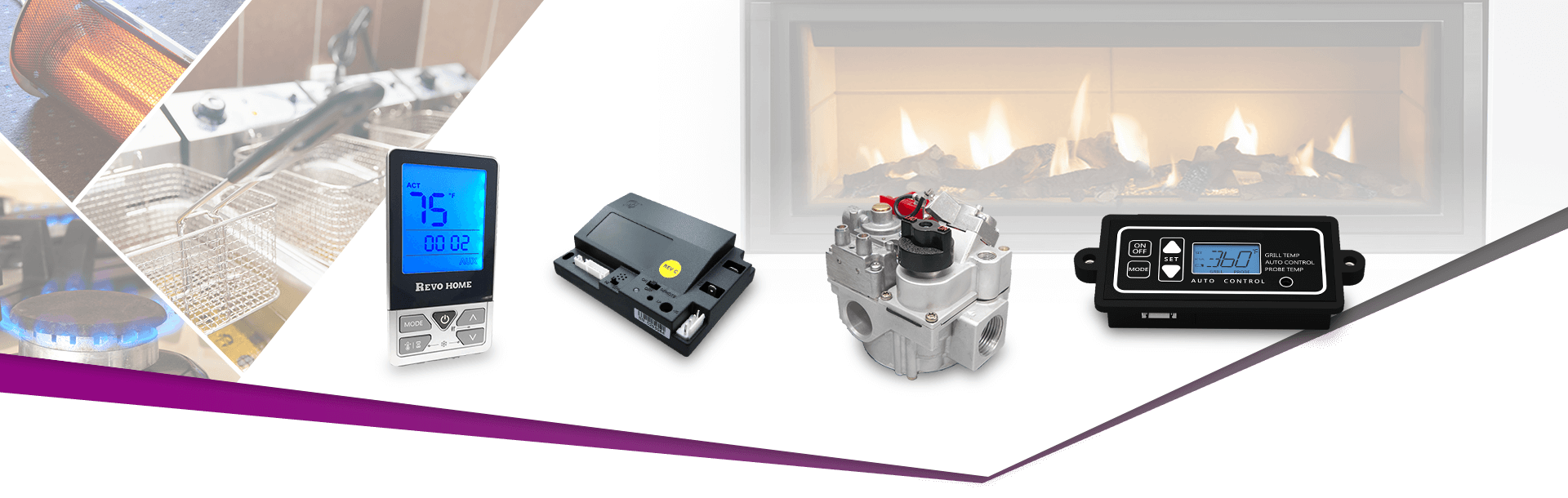
Grand Mate is a Taiwanese manufacturer of gas valves, gas ignition control modules, gas fireplace remote controls and water heater pilot assemblies, supplying OEM appliance makers across Europe, North America and the Middle East. Its controls are used in fireplaces, gas heaters, water heaters, commercial stoves, barbecues, outdoor heaters and ovens, and can be supplied as single components, as matched control modules, or as finished products.
What actually changes when the same gas control ships to a different market?
Three layers change between markets, and they change independently: the gas itself (family, supply pressure, injector and regulator setting), the certification scheme the appliance is assessed under, and the commercial structure that sells and services the product. A control platform that is right for one market is frequently right for another — after the gas setup is corrected and the certification route is confirmed.
| Layer | What differs | Who resolves it |
| The gas | Family (second or third), nominal supply pressure, injector sizing, regulator set point | Appliance designer with the control supplier |
| The certification | Which scheme applies, which body assesses, which documents travel with the part | Compliance or QA, with the supplier's certificate scope |
| The channel | Distributor, installer network, service and spare parts, local stock | Sales and the local partner |
Treating these as one problem is what makes market entry slow. Treated separately, most of the work is scoped in a single meeting.
Which gas will the appliance actually burn?
The gas family and its nominal supply pressure determine injector sizing and regulator set point, and they differ by market more than most sourcing teams expect. Second-family natural gas is supplied at a nominal 20 mbar as G20 across most of Europe, while third-family LPG is supplied at 28–30 mbar for butane (G30) and 37 mbar for propane (G31). Getting this wrong produces an appliance that lights and still fails certification.
| Gas family | Designation | Nominal supply pressure | Typical use |
| Second family | G20 (natural gas) | 20 mbar (≈ 8.0 in WC) | Most of Europe |
| Second family | G25 / G25.3 | 25 mbar | Parts of the Benelux region |
| Third family | G30 (butane) | 28–30 mbar (≈ 11.2–12.0 in WC) | Cylinder LPG |
| Third family | G31 (propane) | 37 mbar (≈ 14.9 in WC) | Cylinder and bulk LPG |
Why does the gas family drive more redesign than the paperwork?
Because it changes the appliance, not just the file. Moving between families means a different injector, a reset or replaced regulator, a re-check of flame supervision response, and confirmation that the certificate lists that gas. In LPG-dominant markets — much of the Middle East, and large parts of Latin America — an appliance designed around G20 natural gas is a redesign, not a re-label.
North American practice adds a third convention. Datasheets there are written in inches of water column and BTU/h, so a control factory-set to regulate at 3.5 in WC is regulating at about 8.7 mbar. The conversion is simple (1 mbar ≈ 0.40 in WC; 1 kW ≈ 3,412 BTU/h) but the set point still has to suit the appliance. The full parameter list is in our guide to specifying a combination gas control valve.
Why can't one certificate cover every market?
No single certificate covers every market, because conformity assessment schemes are territorial and are not mutually recognised. A CE marked control is not automatically acceptable in North America, a CSA certified control is not acceptable in the EU, and neither is automatically sufficient elsewhere. The certificate also covers named models, specific gas families and a defined capacity range — so scope matters as much as existence.
European Union. Regulation (EU) 2016/426 has applied since 21 April 2018. A gas control is a fitting under Article 2(2), it carries the CE marking in its own right, and every conformity assessment route in Article 14 involves a notified body. The regulation is published on EUR-Lex and the European Commission maintains the framework and its harmonised standards. What to request from a supplier is covered in our guide to gas valve CE certification under EU 2016/426.
Türkiye. Türkiye's technical legislation in harmonised areas is closely aligned with EU law, so an EU-based technical file is normally the starting point rather than a fresh programme. It is still a separate national requirement, and the current national implementation and any local conformity assessment step should be confirmed for the specific appliance category before design freeze.
The Gulf states. The Gulf Conformity Mark (G-Mark) scheme, administered under the Gulf Standardization Organization, currently mandates low-voltage electrical equipment and toys, with its scope being extended. Gas appliances are therefore not covered by a single Gulf-wide mark today, and requirements are established country by country — Saudi Arabia's national conformity platform being the most commonly encountered.
The practical conclusion is the same in all three cases: confirm the requirement for the specific appliance category and market before the design is frozen, not after the first shipment is booked.
How do you establish a market's requirement before design freeze?
Establish the requirement in five steps, in this order: define the appliance category and rated input, confirm the gas families and supply pressures of the target market, identify the applicable scheme and assessment body, check what the supplier's existing certificates already cover, and only then decide whether the project needs a new certification programme. Running these out of order is what produces late-stage surprises.
| Step | Question to answer | Output |
| 1 | What is the appliance category and its rated input in kW? | The scheme's product scope, and the standards likely to apply |
| 2 | Which gas families and supply pressures does the market use? | Injector, regulator set point, and the gases the certificate must list |
| 3 | Which scheme applies, and which body assesses it? | The certification route and its documentation format |
| 4 | What do the supplier's existing certificates already cover? | The gap — often smaller than assumed |
| 5 | Is a new certification programme needed, or an extension? | Budget, timeline and who carries which task |
Step 4 is the one most often skipped. A control already certified for a second-family gas at a given capacity may cover a new project outright, and confirming that takes an email rather than a quarter.
Component, module or finished product — which supply form fits the market?
Three supply forms suit different market positions: components for OEMs with their own certification programme, matched control modules for OEMs who want the interface work moved to the supplier, and finished products for distributors and brand owners entering a category without an engineering team. The right choice usually follows the buyer's role rather than the region.
| Supply form | What is supplied | Suits |
| Component | A single certified control — for example a combination gas valve or a gas ignition control module | Appliance OEMs running their own certification, with an existing control architecture |
| Module | Valve plus pilot assembly, ignition module and, where relevant, a fireplace remote control | OEMs who want interface and compatibility work handled upstream |
| Finished product | A complete appliance from the finished product range | Distributors and brand owners entering a category quickly |
Buying a module rather than separate parts moves the interface problem out of your bill of materials — which for a smaller engineering team is usually the point.
What does Grand Mate look for in a distribution partner?
Grand Mate is actively looking for distribution and agency partners in Europe, Türkiye and the Middle East. The partners this works best with hold local channel relationships, can provide technical support rather than only logistics, and can carry stock for the replacement and service market as well as new OEM projects.
What Grand Mate provides:
- Five product lines: gas valves, gas ignition control modules, gas fireplace remote controls, water heater pilot assemblies and finished products
- Certification documentation — including Gas Appliances Regulation certification through Intertek under certificate ITS-2575-GAR-2232029, and CSA certificate of compliance 80169629 for North American programmes, both published on the certification page
- Engineering support for specification, gas conversion and interface questions, backed by an in-house testing laboratory accredited to ISO/IEC 17025 under TAF L2216-230614
- Samples and technical documentation for local qualification
What works on the partner side:
an established customer base in gas appliances or HVAC, the ability to answer a technical question without escalating every time, and a realistic view of the local replacement market — which in mature European and Middle Eastern markets is frequently larger and steadier than new OEM projects.
Frequently asked questions
Can one gas control be approved for both the EU and the Gulf states?
Not through a single certificate. Conformity assessment schemes are territorial and are not mutually recognised, so an EU certificate does not automatically satisfy requirements elsewhere. The same hardware platform can normally serve both, however, because what differs between the routes is the assessment and its documentation rather than the valve itself. Confirm the requirement for the specific appliance category and market before design freeze.
What changes when an appliance moves from natural gas to LPG?
Injector sizing, regulator set point, flame supervision response and the gases listed on the certificate. Supply pressures differ substantially — a nominal 20 mbar for G20 natural gas against 28–30 mbar for G30 butane and 37 mbar for G31 propane — so this is a design change, not a field adjustment. In LPG-dominant markets an appliance designed around G20 needs redesign, not relabelling.
Do you supply components only, or complete control modules and finished appliances?
All three. Grand Mate supplies single certified components, matched modules combining a valve with a pilot assembly, ignition module and remote control, and complete finished products. The supply form usually follows the buyer's role: OEMs with their own certification programme buy components, OEMs without an interface team buy modules, and distributors entering a category buy finished products.
Are you looking for distributors and agents in Europe and the Middle East?
Yes. Grand Mate is looking for distribution and agency partners in Europe, Türkiye and the Middle East, particularly partners with an existing customer base in gas appliances or HVAC, local technical support capability, and the ability to hold stock for the replacement market. Contact us with your territory, the categories you cover and your current customer profile.
What certification documents can you provide for an export project?
Grand Mate can provide the EU declaration of conformity, the Intertek Gas Appliances Regulation certificate ITS-2575-GAR-2232029, CE certification covering the GM982A gas valve, ISO 9001:2015 certification, and CSA certificate of compliance 80169629 for North American programmes. Testing is supported by an in-house laboratory accredited to ISO/IEC 17025 under TAF L2216-230614.
How long does it take to confirm whether an existing control suits a new market?
Usually a few working days, provided the enquiry includes the appliance category and rated input, the gas families and supply pressures of the target market, the electrical interface and the certification the appliance will be assessed under. Most of that time is spent checking existing certificate scope, which is why step 4 of the five-step method matters more than it looks.
Tell us the market, and we will tell you what is already covered
If you are taking a gas appliance into Europe, Türkiye or the Middle East, the useful first question is not "can you make this valve" but "what does your existing certificate already cover for my market?" That answer is often larger than expected, and it usually arrives within a few working days.
Send us the appliance category and rated input, the gas families and supply pressures of your target market, the electrical interface, and the certification the appliance will be assessed under. If you are a distributor rather than an OEM, tell us your territory, the product categories you cover and your current customer profile instead.
Start with the product range or the application overview if you would rather see the scope first.
Contact us: https://www.grandmate.com/contact/contact.html
Email: [email protected]