
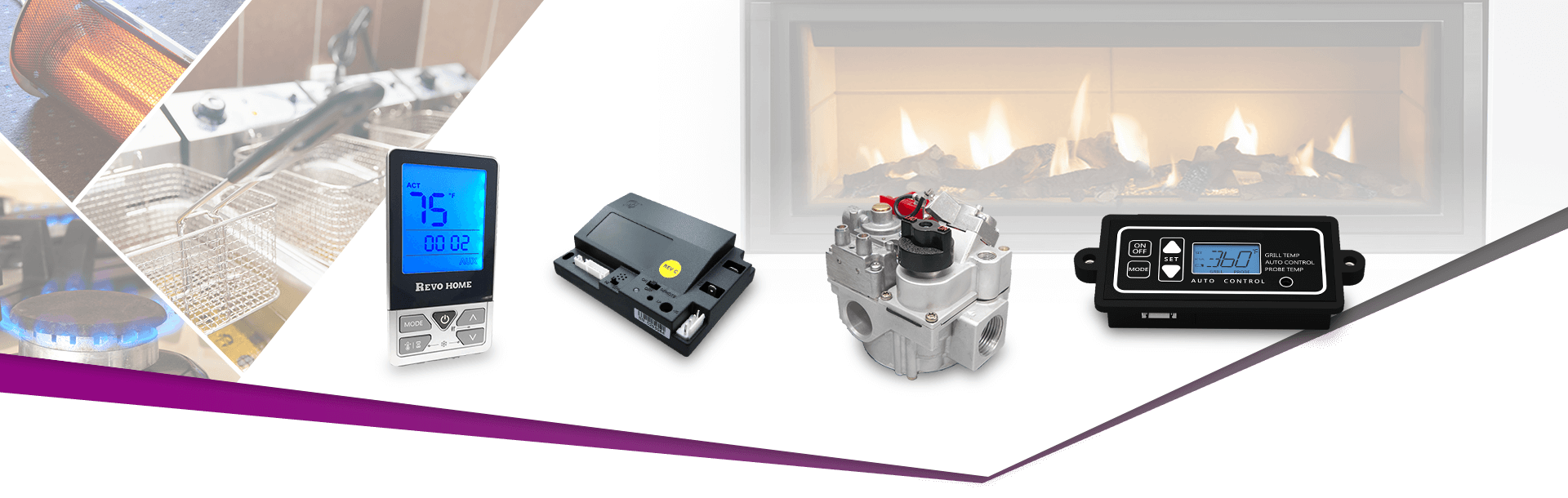
A gas fireplace control system has four layers: the gas valve, the ignition control module, the pilot assembly and the user interface. On a modular platform, each layer is chosen on its own. The OEM picks the ignition method, decides whether the model ships with or without a remote, and adds Bluetooth or app control only where the model needs it — and none of these choices depends on the gas the appliance burns. One firebox and one gas train can therefore be sold at several feature levels without re-engineering the appliance for each one.
This guide is written for fireplace, stove and gas heater manufacturers, particularly in Europe, who are planning their next model range. It explains the four layers, shows the five standard system configurations with their system diagrams, and lists what to check before a platform goes to a new market.
Grand Mate is a Taiwanese manufacturer of gas valves, gas ignition control modules, gas fireplace remote controls and pilot assemblies, supplying appliance makers in Europe, North America and the Middle East. Its gas fireplace electronic ignition valve kits are built as one control platform: the parts are designed to work together, and each one is also available on its own.
What makes up a gas fireplace control system?
A gas fireplace control system is made up of four layers, each with a separate job. The valve meters the gas, the ignition module runs the safety sequence, the pilot assembly lights and proves the flame, and the user interface is what the owner touches. Because the layers meet at defined gas, electrical and signal connections, they can be specified one by one.
| Layer | What it does | Grand Mate range | Chosen by |
|---|---|---|---|
| Gas valve | Opens, closes and regulates gas to the pilot and main burner | Standing pilot and millivolt gas valves | Gas type, supply pressure, input range |
| Ignition control module | Lights the pilot, proves the flame, opens the main burner, shuts down on flame loss | Gas ignition control modules | Power source, functions, certification |
| Pilot assembly | Carries the pilot orifice, ignition lead and flame sensor | Pilot assembly | Gas type, firebox layout |
| User interface | Wall switch, handheld remote, Bluetooth or smartphone app | Gas fireplace remote controls and the Gateway module | Model tier and target market |
Every Grand Mate ignition module listed for fireplace use applies ionization flame detection, so gas flows to the main burner only while a stable flame is proven. That safety function stays inside the module whichever interface sits on top of it. The wider set of safety functions in a gas valve is covered in our article on gas valve safety features.
Why choose a modular platform instead of a fixed combination?
A modular platform lets the appliance maker decide each layer separately, instead of accepting a valve, receiver, handset and app as one fixed package. In Europe, fireplace makers often find their choice of control systems narrow: established systems tend to be sold as fixed combinations, in which choosing the valve also decides the handset and the app. A modular platform reverses that order. The appliance decides the controls, rather than the controls deciding the appliance.
In practice this gives three advantages:
- One design, several price points. The same firebox, burner and valve can carry a basic, remote-controlled or app-controlled package.
- Upgrades without a new gas train. Remote or app control is added at the module and interface layers, while the gas path stays as it is.
- Fewer spare parts in the field. Models built on one platform share valves, pilot assemblies and modules, which keeps the service stock small.
How can one firebox become several model tiers?
One firebox becomes several model tiers by keeping the gas layers fixed and changing only the module and the interface. A typical range looks like this:
| Model tier | What the owner gets | Interface |
|---|---|---|
| Entry | Electronic ignition, on/off | Wall switch, no remote |
| Comfort | On/off, flame height, thermostat | Handheld remote |
| Premium | Adds timer, fan, light, AUX output and a second burner | Full-function remote |
| Connected | Adds smartphone control | Remote plus app via a gateway |
What are the five standard system configurations?
Grand Mate's fireplace controls are organised into five standard IPI (intermittent pilot ignition) configurations, each documented with a system diagram that shows the gas path, the wiring and the user interface. The same diagrams are used when a configuration is proposed for a project. Each configuration is built around a module family identified in the module comparison on the ignition control page.
Basic IPI system
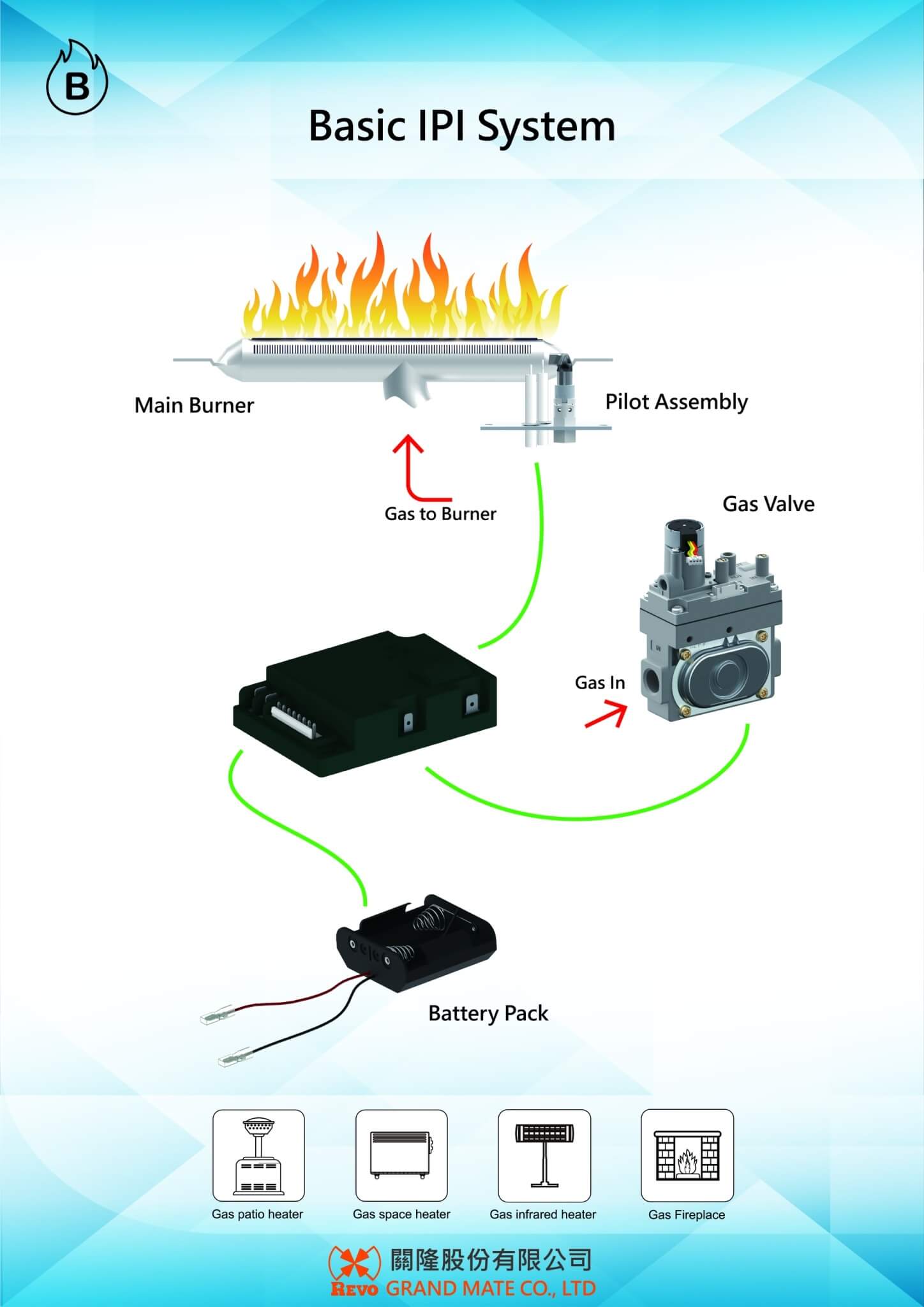
The basic IPI system connects a gas valve, an ignition module, a pilot assembly and a battery pack to the main burner. It lights on demand and has no remote. It suits entry models and appliances where the owner switches the fire on and off locally. The 6K module is the basic module family, powered by an adapter or batteries.
Remote control IPI system
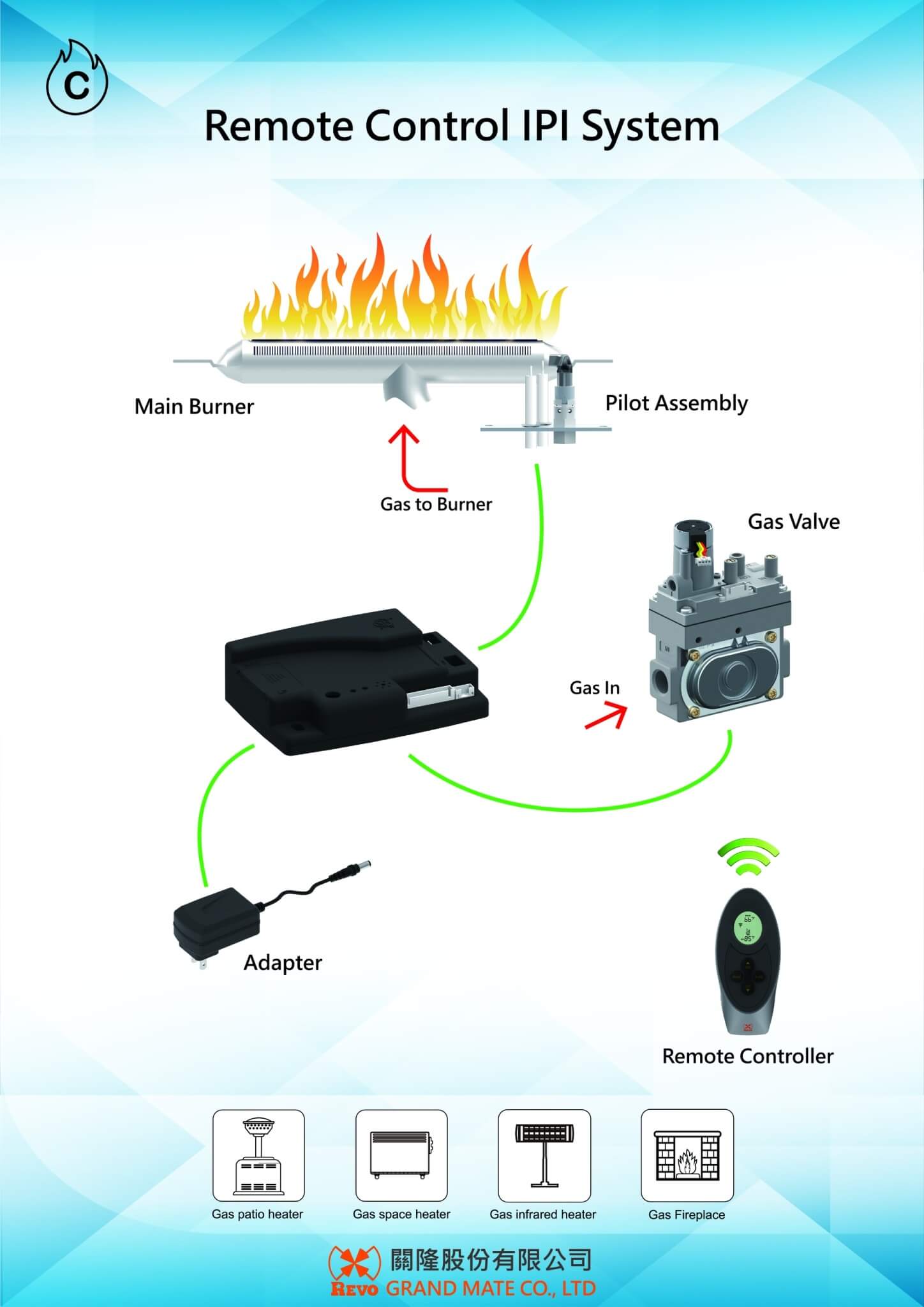
The remote control IPI system adds a handheld remote and an adapter to the basic layout. The GM6KR and the 8K module are the remote-control families, and the 8K adds flame height modulation. Remote tiers run from the compact RFC remote to the TX580, which adds an LCD, thermostat and programmable thermostat, timer, fan speed, light dimmer, AUX output, second burner control and an Independent Access Key for childproof operation.
Thermopile-powered IPI system
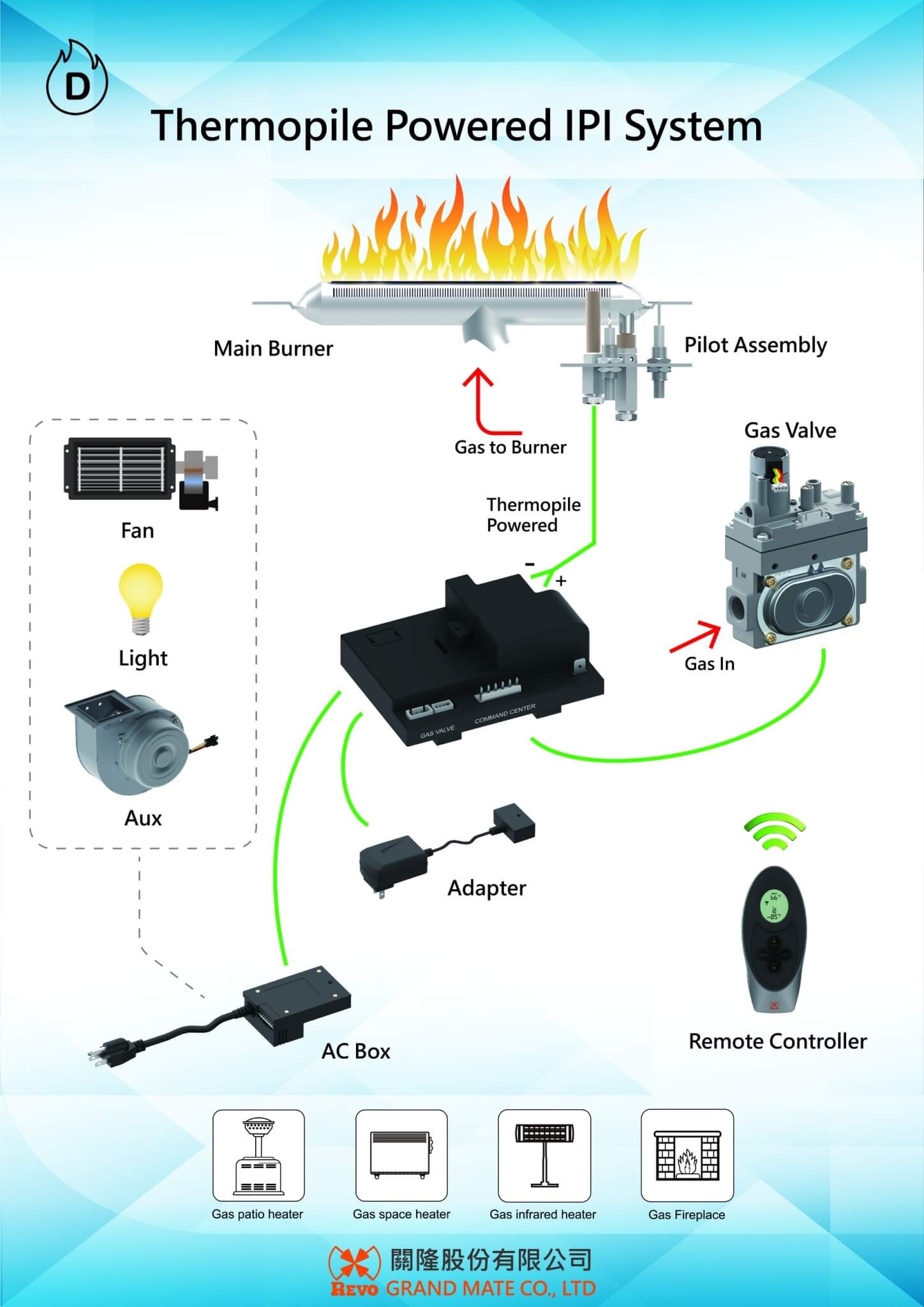
The thermopile-powered IPI system draws power for the module from a thermopile at the pilot assembly. An AC box supplies the fan, light and AUX outputs. It suits designs that must keep working where mains power is limited. The GM8K1-N and GM931 are the thermopile-powered module families.
Smartphone control IPI system
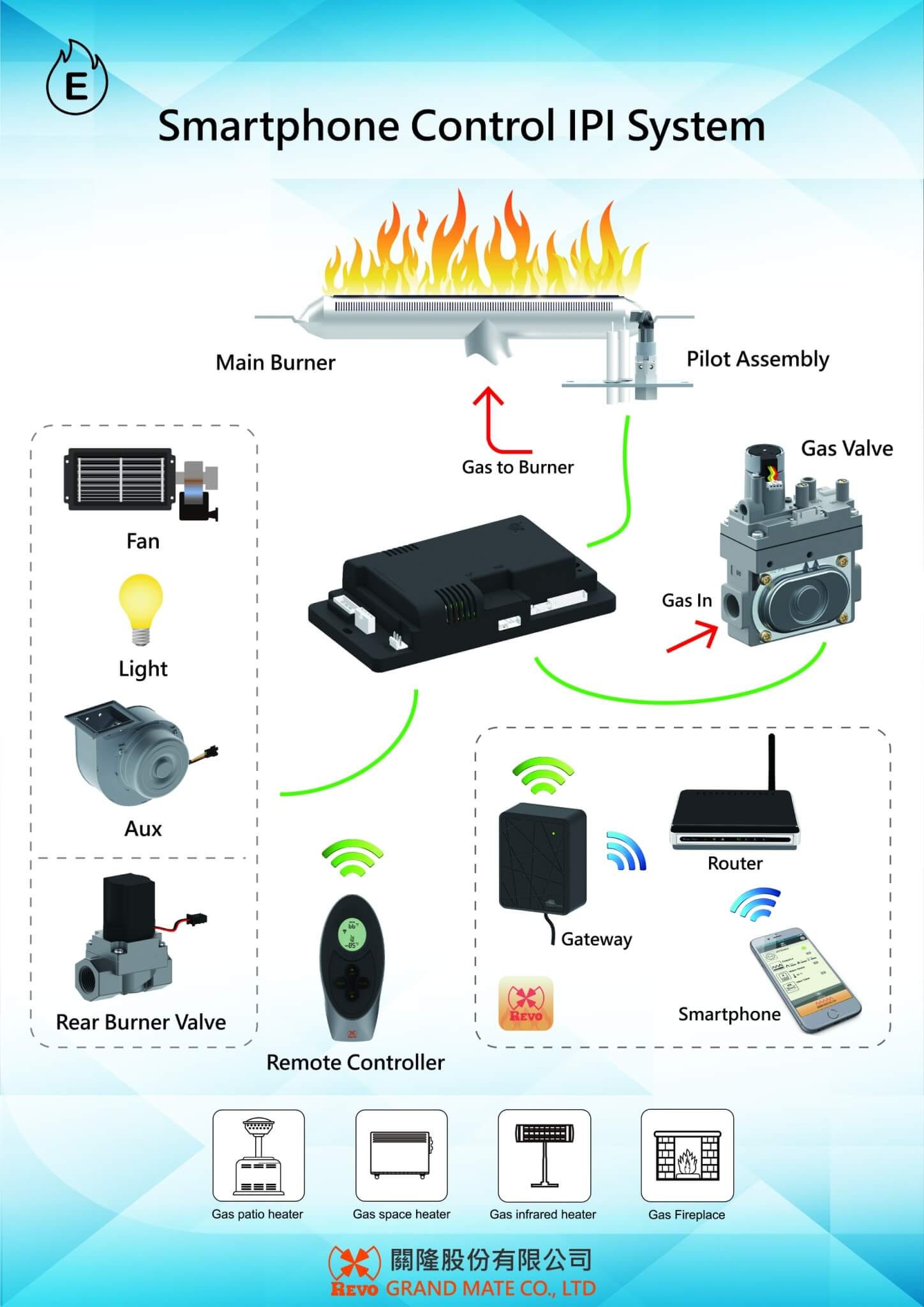
The smartphone control IPI system adds app control through a Gateway module and the home router, alongside a handheld remote. It also drives a fan, a light, an AUX output and a rear burner valve. The 9K series, including the 9K2, is the smartphone-control family, and Bluetooth is available on selected variants. The app side is described on the smart control page.
MFC IPI system
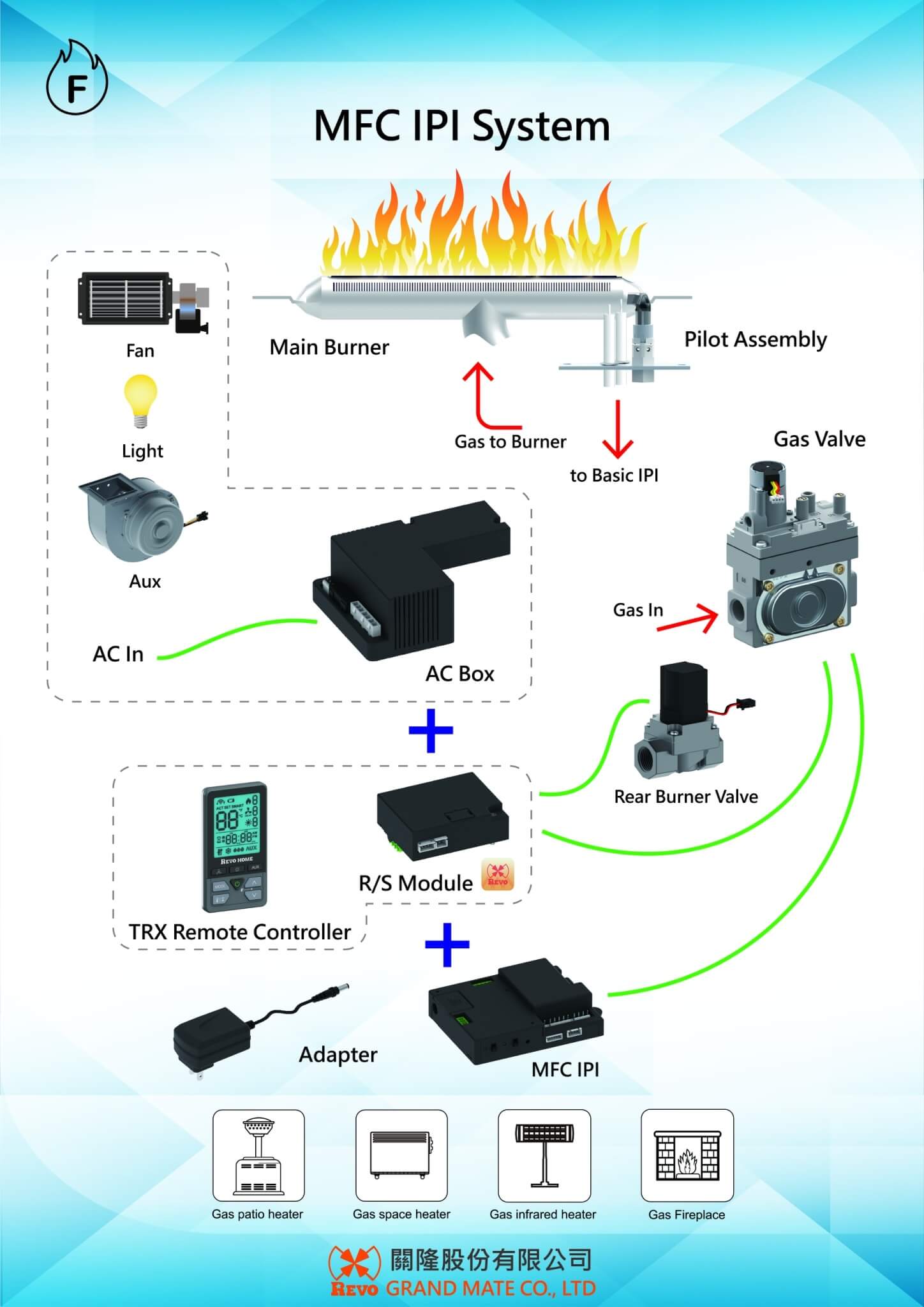
The MFC (Modularize Function Control) IPI system is the most literal form of the platform. It starts from an MFC IPI module and an adapter, then adds function blocks: an R/S module paired with a TRX series remote, an AC box for the fan, light and AUX outputs, and a rear burner valve for a second burner. Each block is added only when the model needs it.
| Configuration | Module family | Power | User interface | Optional outputs |
|---|---|---|---|---|
| Basic IPI | 6K | Adapter or battery | None (local switch) | — |
| Remote control IPI | GM6KR, 8K | Adapter or battery | Handheld remote | Flame height (8K) |
| Thermopile-powered IPI | GM8K1-N, GM931 | Thermopile, with adapter or AC box | Handheld remote | Fan, light, AUX |
| Smartphone control IPI | 9K series | Adapter, AC or battery | Remote, Bluetooth on selected variants, app via Gateway | Fan, light, AUX, second burner |
| MFC IPI | MFC | Adapter, AC or battery | TRX remote via R/S module | Fan, light, AUX, second burner |
The same four appliance types appear under every diagram: gas patio heaters, gas space heaters, gas infrared heaters and gas fireplaces. The platform is not limited to fireplaces; see also the gas heater, space heater and patio heater applications.
Can the same model be offered with and without a remote?
Yes. Remote control is a choice at the module and interface layers, so the same model can be sold in both versions. Grand Mate builds this in three ways:
- Paired module versions. The GM6K and GM6KR are both IPI modules powered by an adapter or batteries; the GM6KR adds remote control.
- Add-on modules. The GM650 series adds remote control, Bluetooth control or a dry-contact connection to a system.
- Function blocks on the MFC platform. The R/S module and TRX remote are added to the MFC IPI module only for the models that need them.
Planning both versions at the start costs less than adding one later. Once an appliance is certified, a change to its control system is assessed by the appliance maker and its certification body.
Does the control system change with the gas type?
No. The ignition module and user interface are independent of the gas the appliance burns. Moving between natural gas and LPG changes the valve, or its gas setting, and the pilot orifice, while the module, the remote and the app stay the same.
- Valve: the 6003V is a natural gas valve, the H3V is an LPG valve, and the M6003V serves both natural gas and LP.
- Pilot assembly: the pilot orifice is ∅0.45 for natural gas and ∅0.3 for LP.
This is why the same control platform can serve markets with very different gas supplies. The gas families and supply pressures used across Europe, Türkiye and the Middle East are set out in our guide to sourcing gas controls for the EU, Türkiye and the Middle East.
What should you check before taking the platform to Europe?
Check four things before a configuration is committed to a European model: the gas setup, the certificate scope of each part, the energy-efficiency rules, and the radio approvals for the user interface. The platform itself does not change; what changes is the evidence each layer has to carry.
- Gas families and supply pressures. Confirm the gases and pressures of each target country and select the valve and pilot orifice to match.
- Certificate scope, part by part. Gas fittings carry the CE marking under Regulation (EU) 2016/426, as explained in our guide to gas valve CE certification. The module comparison on the ignition control page marks which module variants carry CE certification, and Grand Mate's certificates are published on the certification page.
- Ecodesign. For local space heaters, Regulation (EU) 2024/1103 has applied since 1 July 2025. The type of temperature control, timer functions and certain additional control functions enter the seasonal space heating efficiency calculation, so the interface tier is also an efficiency decision.
- Radio approvals. Remote, Bluetooth and Wi-Fi interfaces need the approvals required for radio equipment in each target market, confirmed for the specific model.
How do you read a system diagram before a project starts?
Read a system diagram along three paths: gas, power and signal. Together they show whether a configuration fits the appliance before any sample is built.
- Gas path: gas in at the valve, out to the pilot and the main burner, and to any second burner valve.
- Power path: battery, adapter, AC box or thermopile, and what still works during a power cut.
- Signal path: handheld remote, Bluetooth, or Gateway, router and smartphone.
- Optional loads: fan, light, AUX output and a rear burner, each needing an output on the module.
When a project is discussed, Grand Mate usually starts by sending the system diagram for the proposed configuration, so that the appliance maker's engineers can check these paths against their own design.
Standard configuration or custom development?
Most programmes are best served by one of the five standard configurations, because the parts have already been matched and used together. This shortens development and reduces interface risk. Changes to the interface, control logic or appearance are possible. They involve a development charge and make sense where the programme's volume justifies the engineering work.
Testing is backed by Grand Mate's in-house laboratory, accredited to ISO/IEC 17025 under TAF L2216-230614.
Frequently asked questions
What components make up a gas fireplace control system?
A gas fireplace control system has four layers: a gas valve, an ignition control module, a pilot assembly and a user interface, which can be a wall switch, a handheld remote, Bluetooth or a smartphone app. The module runs the safety sequence and proves the flame, so the gas reaches the main burner only while a flame is present.
Can the same fireplace be offered with and without a remote control?
Yes. Remote control is chosen at the module and interface layers, so one model can be sold in both versions. Grand Mate offers paired module versions such as the GM6K and GM6KR, add-on modules in the GM650 series, and function blocks on the MFC platform. Planning both versions at the start avoids a later change to the certified control system.
Does the control system change between natural gas and LPG?
No. The ignition module, remote and app are independent of the gas type. Moving between natural gas and LPG changes the valve, or its gas setting, and the pilot orifice. Grand Mate's pilot assembly uses a ∅0.45 orifice for natural gas and ∅0.3 for LP, and the M6003V valve serves both gases.
Can remote or app control be added to an existing model later?
At the parts level, yes: add-on modules and the MFC function blocks add remote, Bluetooth or app control without changing the gas path. For an appliance that is already certified, however, a change to the control system is assessed by the appliance maker and its certification body. Planning the interface options at the design stage is the simpler route.
What information do you need to propose a control system?
Send the appliance type and input range, the gas types and supply pressures, the power source, the interface tiers you plan to offer, any optional outputs such as a fan, light or second burner, and the target markets with their certification route. Expected annual volume helps too. Grand Mate will reply with a recommended configuration and its system diagram.
Tell us your model range, and we will send the system diagram
If you are planning a new fireplace, stove or gas heater range, start from the model tiers rather than the part numbers. Tell us the appliance type and input range, the gas types, the power source, which models need a remote or app control, and the markets you are selling into. We will come back with a recommended configuration from the platform, its system diagram, and the certificate scope that supports it.
You can also browse the fireplace applications and the insert fireplace controls first.
Contact us: https://www.grandmate.com/contact/contact.html
Email: jimmy@grandmate.com.tw