
Ecodesign Regulation (EU) 2024/1103 for Gas Fires: How Your Control System Changes Seasonal
This guide is written for fireplace, stove and gas heater manufacturers selling into Europe. It explains what changed, how each control function is counted, which limits apply to the controls themselves, and what to ask a control supplier before design freeze.
Grand Mate is a Taiwanese manufacturer of gas valves, gas ignition control modules, gas fireplace remote controls and pilot assemblies for appliance makers in Europe, North America and the Middle East. Its controls are built as one modular gas fireplace control platform, so the control tier of each model can be chosen to suit its efficiency target.
I.What changed when Regulation (EU) 2024/1103 replaced 2015/1188?
For gaseous fuel local space heaters, the regulation sets these minimum values for seasonal space heating energy efficiency (ηs) and these NOx limits:
| Gaseous fuel local space heater type | Minimum seasonal space heating efficiency (ηs) | NOx limit |
|---|---|---|
| Open fronted and open to chimney | 40.3% | 120 mg/kWh input (GCV) |
| Closed fronted open combustion | 63.6% | 120 mg/kWh input (GCV) |
| Balanced flue | 63.6% | 120 mg/kWh input (GCV) |
The 120 mg/kWh NOx limit also applies to flueless gaseous fuel local space heaters.
Three scope points matter for gas fire makers:
- Outdoor heaters are excluded when they are designed, tested, marketed and declared exclusively for outdoor use.
- Decorative intent is not an exclusion. The regulation has no general exemption for decorative appliances, and a product cannot be treated as out of scope if its design, use or marketing does not clearly distinguish it from a covered heater.
- A review is scheduled. The Commission must review the regulation by 9 May 2029.
The full text is published on EUR-Lex as Regulation (EU) 2024/1103.
II.How do controls enter the seasonal efficiency calculation?
| Factor | What it represents | Effect on ηs |
|---|---|---|
| ηth,nom | Useful efficiency at nominal heat output, based on net calorific value | Starting point |
| 0.75 | Base factor for a heater with no heat output control | Fixed |
| F(2) | Type of heat output or room temperature control; only one option applies | Raises ηs |
| F(3) | Additional control functions; several can be added together | Raises ηs |
| F(4) | Auxiliary electricity consumption at nominal and minimum heat output | Lowers ηs |
| F(5) | Permanent pilot flame consumption | Lowers ηs |
The base factor of 0.75 is the critical point. A gas fire with single-stage heat output and no room temperature control keeps only 75% of its useful efficiency before any other factor is applied. Every control function the appliance carries is added on top of that base.
What does that mean in practice?
The following illustrative calculation assumes a closed-fronted gas fire with a useful efficiency of 85%, no permanent pilot flame and no auxiliary electricity consumption, so F(4) and F(5) both equal 1. It is an example of the method, not a product value.
| Control package | 0.75 + F(2) + F(3) | Resulting ηs | Against the 63.6% minimum |
|---|---|---|---|
| Single stage, no room temperature control | 0.75 | 63.75% | Only 0.15 points above |
| Electronic room temperature control plus week timer | 0.90 | 76.5% | 12.9 points above |
| As above, plus open window detection and distance control option | 0.95 | 80.75% | 17.15 points above |
The same burner produces a compliant-but-marginal appliance or a comfortable one, depending only on its controls. That margin matters, because measured efficiency, verification tolerances and production variation all eat into it.
III.Which temperature controls count for F(2)?
| Heat output or room temperature control (one option only) | F(2) |
|---|---|
| Single stage heat output, no room temperature control | 0 |
| Two or more manual stages, no temperature control | 0.025 |
| Mechanic thermostat room temperature control | 0.050 |
| Electronic room temperature control | 0.100 |
| Electronic room temperature control plus day timer | 0.125 |
| Electronic room temperature control plus week timer | 0.150 |
The top value depends on a precise definition. The regulation defines electronic room temperature control plus week timer as a device that automatically varies the heat output and lets the user set timing and temperature levels for a full week. A programmable thermostat qualifies for 0.150 only if its programming meets that definition. Otherwise it is assessed at the day-timer or plain electronic level.
IV.Which extra control functions add to F(3)?
| Additional control function (several may apply) | F(3) |
|---|---|
| Room temperature control with presence detection | 0.025 |
| Room temperature control with open window detection | 0.025 |
| Distance control option | 0.025 |
| Adaptive start control | 0 |
| Working time limitation | 0 |
| Black bulb sensor | 0 |
| Self-learning functionality | 0.0125 |
| Control accuracy with CA < 2 K and CSD < 2 K | 0.0125 |
The distance control option is the function most often misread. The regulation defines it as a function that allows remote interaction with the product's control from outside the building in which the heater is installed. A handheld remote used in the same room does not meet that definition, and neither would a local Bluetooth link on its own. An app connection earns the factor only when it works from outside the building.
Open window detection is also defined narrowly. It must automatically switch the heater to frost protection, or limit its consumption to idle-mode level, when a window or door has been opened.
V.Why do the pilot flame and the controls' own power use still matter?
F(5), the permanent pilot flame. For gaseous fuel heaters other than commercial units, F(5) = 1 / (1 + 0.5 × Ppilot / Pnom), where Ppilot is the pilot flame consumption and Pnom the nominal heat output. The regulation counts a pilot as a permanent pilot flame when it is lit for more than five minutes before the main burner is on, and the transitional measurement method refers to EN 1266:2002, clause 7.3.4. Intermittent pilot ignition, which lights the pilot only on a call for heat, avoids this penalty in normal operation.
F(4), auxiliary electricity. F(4) reduces ηs according to the electric power the appliance draws at nominal and minimum heat output (elmax and elmin). A module, fan or display with high consumption costs efficiency points.
Low power modes. Local space heaters with controls, and separate related controls, must meet these limits:
| Mode | Limit |
|---|---|
| Off mode | 0.50 W; 0.30 W from 9 May 2027 |
| Standby mode | 0.50 W |
| Standby with information or status display | 1.00 W |
| Networked standby | 2.00 W; 3.00 W where heater and control communicate wirelessly or by powerline |
| Idle mode | 1.00 W averaged over one hour; 3.00 W where idle mode depends on a network connection |
The off-mode limit tightens to 0.30 W from 9 May 2027. Models planned now for the 2027/28 season should be checked against that value, not the current one.
Is the energy label calculated the same way?
No. The EU energy label for local space heaters is still governed by Delegated Regulation (EU) 2015/1186, which has been under review since 2022. Its correction factors are expressed differently: electronic room temperature control plus week timer, for example, is worth 7.0% in its fuel-heater table. The label figure and the ecodesign figure are therefore separate calculations, and both should be checked when a model's controls change.
VI.How does a modular control platform map to these factors?
| Grand Mate configuration | Control functions on the platform | Factor it relates to | What to confirm for the declaration |
|---|---|---|---|
| Basic IPI, 6K module, no remote | On/off, intermittent pilot | F(2): single stage, no room temperature control | Whether the appliance has any other heat output control |
| Remote control IPI, 8K module with RFC remote | On/off, flame height modulation by remote | F(2): depends on how the heat output setting is classified | How remote flame adjustment is classified for the appliance |
| Full-function IPI, 9K module with TX580 remote | Thermostat, programmable thermostat, timer | F(2): electronic room temperature control, with day or week timer if the programming meets the definition | Whether timing and temperature can be set for a full week |
| Smartphone control IPI, 9K with Gateway module | App control through the home router | F(3): distance control option, only if usable from outside the building | The remote access path and what the app can change |
| Pilot logic on any IPI configuration | Pilot lit on a call for heat; standing pilot mode on selected modules | F(5): permanent pilot flame | Which pilot mode the appliance is declared in |
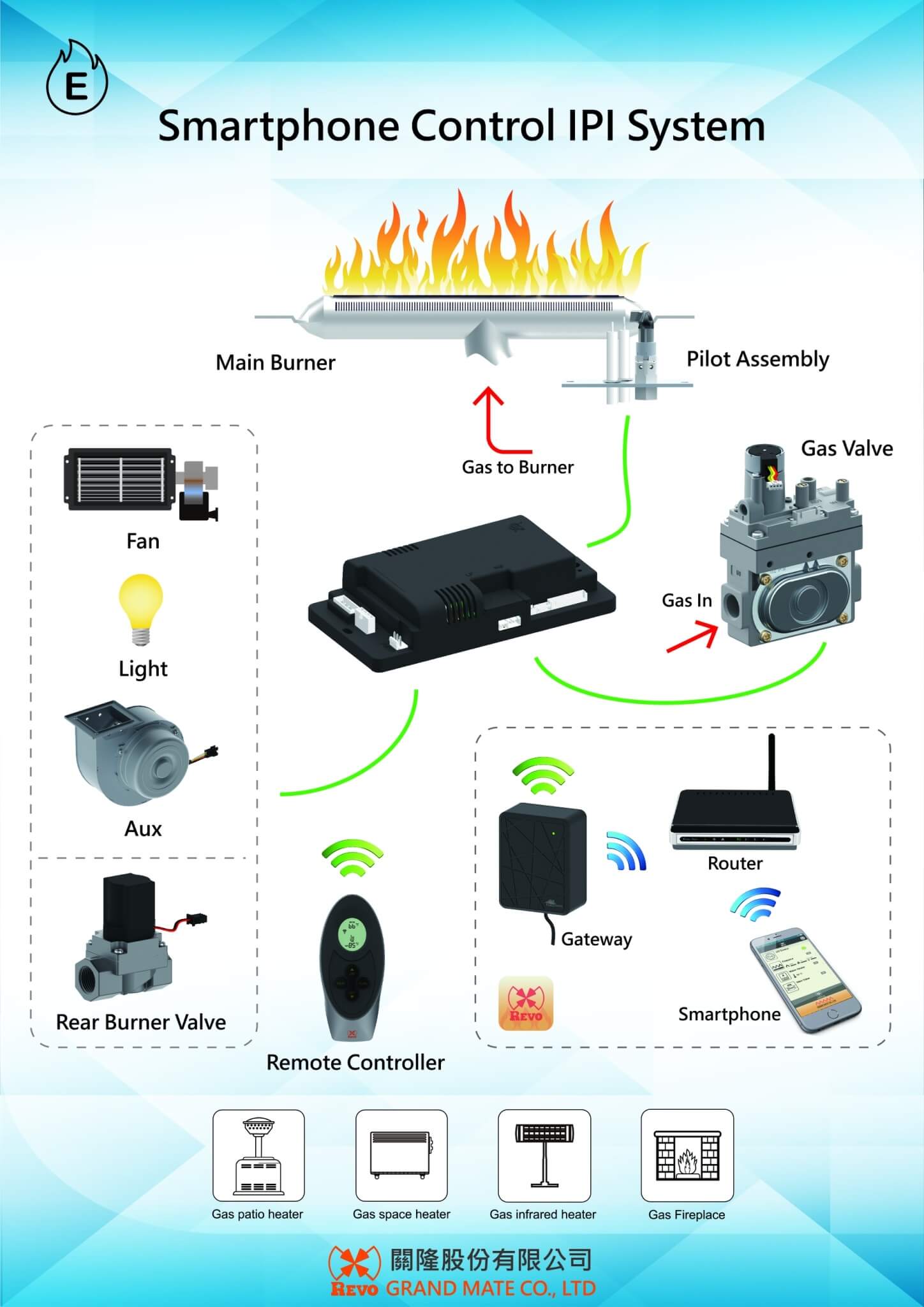
The full set of configurations, with their system diagrams, is described in our guide to the modular gas fireplace control system. The functions on each module are listed in the comparison table on the gas ignition control modules page, and app control is described on the smart control page.
VII.What should you ask your control supplier before design freeze?
-
1Temperature control type. Is room temperature control mechanical or electronic, and where is the sensor? Can control accuracy (CA) and control set-point deviation (CSD) below 2 K be demonstrated?
-
2Timer programming. Does the timer set timing and temperature for one day or for a full week?
-
3Remote access path. Does the app work from outside the building, or only on the local network or Bluetooth?
-
4Pilot logic. Is the pilot intermittent, or can the module run a standing pilot mode? Which mode will the appliance be declared in?
-
5Electricity data. What are the module's consumption values at nominal and minimum output, in standby, in networked standby and in off mode, and do they meet the 0.30 W off-mode limit that applies from 9 May 2027?
Gas safety requirements still apply alongside ecodesign. Gas fittings carry the CE marking under Regulation (EU) 2016/426, as explained in our guide to gas valve CE certification.
VIII.Which dates should a 2026–2029 model plan include?
9 May 2024
Anti-circumvention article of Regulation (EU) 2024/1103 applies
1 July 2025
Regulation (EU) 2024/1103 applies; Regulation (EU) 2015/1188 is repealed
9 May 2027
Off-mode power limit falls from 0.50 W to 0.30 W
By 9 May 2029
The Commission reviews the regulation, including efficiency and emission requirements and the correction factors
A model launched in 2027 will be on sale when that review is carried out. Building margin into the control package now is cheaper than redesigning it later.
IX.How does Grand Mate support European gas fire programmes?
For European projects, the module comparison marks which module variants carry CE certification. Grand Mate holds Gas Appliances Regulation certification through Intertek under certificate ITS-2575-GAR-2232029, published on the certification page, and its in-house laboratory is accredited to ISO/IEC 17025 under TAF L2216-230614. How certification scope differs between the EU, Türkiye and the Middle East is covered in our guide to sourcing gas controls for the EU, Türkiye and the Middle East.
Frequently asked questions
Plan the control tier before you freeze the design
If you are planning a gas fire range for Europe, start from the efficiency target of each model rather than from the part list. Tell us the appliance type and nominal heat output, the efficiency target, the control functions you want each model to offer, and the markets you are selling into. We will propose the Grand Mate configuration for each tier and tell you which functions and documentation each part brings.
You can also browse the fireplace applications and gas heater applications first.
Contact us: https://www.grandmate.com/contact/contact.html
Email: [email protected]